
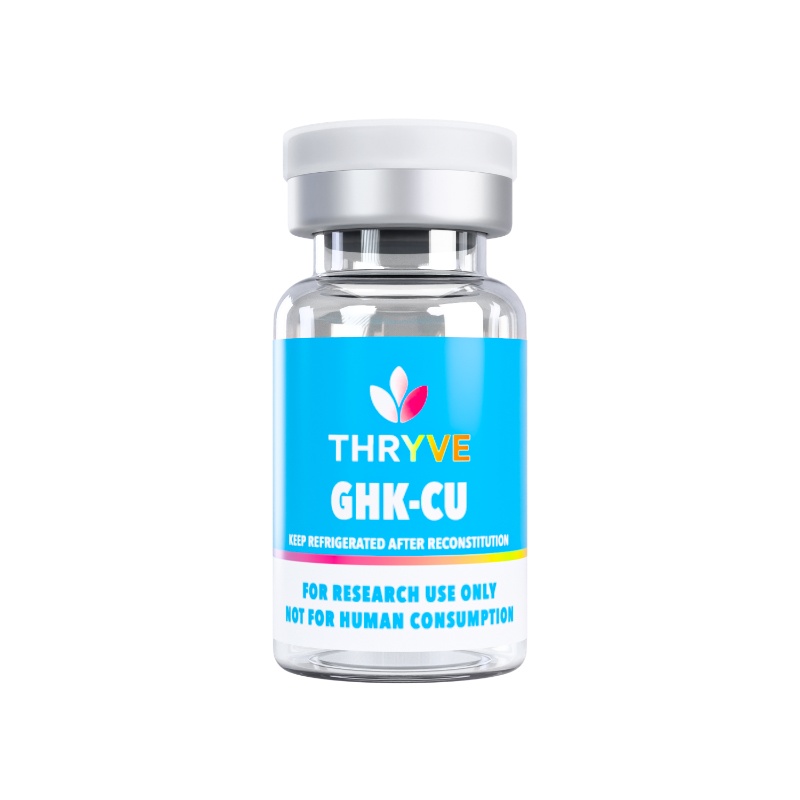
GHK-Cu
Decades of research on this naturally occurring copper-binding tripeptide keep showing consistent activity across collagen synthesis, wound healing, and tissue remodeling models — with gene expression data pointing to one of the broadest regenerative profiles studied to date.
GHK-Cu Overview
GHK-Cu is a naturally occurring copper-binding tripeptide complex consisting of the amino acid sequence glycine-histidine-lysine (GHK) chelated with copper(II) ions. First isolated from human plasma in 1973 by Dr. Loren Pickart, GHK-Cu is found in plasma, saliva, and urine — with plasma concentrations declining significantly with age, from approximately 200 ng/mL at age 20 to 80 ng/mL by age 60.
The copper ion is integral to biological activity. Research across multiple decades has focused on GHK-Cu’s role in collagen and elastin synthesis, glycosaminoglycan production, wound closure, angiogenesis, and more recently, gene expression modulation — where data indicates influence over a remarkably broad range of biological pathways.
History
GHK-Cu was first identified in 1973 when Dr. Loren Pickart isolated an activity in the albumin fraction of human plasma that caused aged liver tissue to synthesize proteins characteristic of younger tissue. That active component was identified as the tripeptide glycyl-L-histidyl-L-lysine, which forms a stable complex with copper(II).
Through the 1980s and 1990s, research expanded to cover wound healing, skin remodeling, and collagen synthesis. More recently, gene profiling data from the Broad Institute’s Connectivity Map has positioned GHK-Cu as one of the most broadly studied peptides in the context of gene expression modulation, with data suggesting influence over tissue repair, antioxidant defense, and anti-inflammatory pathways simultaneously.
Research Findings
GHK-Cu has been studied extensively across dermal, vascular, and systemic models. Research consistently highlights activity in collagen and elastin synthesis, extracellular matrix remodeling, angiogenesis, and fibroblast proliferation. More recent data explores gene expression modulation, with analysis suggesting GHK-Cu influences a broad network of biological pathways tied to tissue integrity and cellular repair.
- Structural: Collagen, elastin, glycosaminoglycan synthesis
- Dermal: Fibroblast proliferation, ECM remodeling, skin repair
- Vascular: Angiogenesis, wound closure, blood vessel formation
- Systemic: Gene expression modulation, antioxidant defense, anti-inflammatory pathways
Together, these findings suggest experimental utility for GHK-Cu across multiple biological systems. Its consistent activity in collagen regulation, vascular support, and gene expression modulation provides a broad research foundation. The data keeps pointing toward GHK-Cu as a versatile platform for studying regenerative and protective biological mechanisms in experimental settings.
Pickart L. et al. — BioMed Research International, 2015 · Pickart L. & Margolina A. — Int. J. Molecular Sciences, 2018
References
- Pickart L. (1973). Human plasma fractions with liver cell growth-promoting properties. First isolation of GHK from human plasma albumin fraction. PubMed ↗
- Maquart FX. et al. (1988). Stimulation of collagen synthesis in fibroblast cultures by the tripeptide-copper complex glycyl-L-histidyl-L-lysine-Cu²⁺. PubMed ↗
- Abdulghani AA. et al. (1998). Topical GHK-Cu in a double-blind trial: collagen increases in 70% of volunteers, outperforming vitamin C and retinoic acid comparators. PubMed ↗
- McCormack MC. et al. (2001). GHK-Cu restored replicative vitality to fibroblasts from patients after anticancer radiation therapy. PubMed ↗
- Pickart L., Vasquez-Soltero JM. & Margolina A. (2015). GHK peptide as a natural modulator of multiple cellular pathways in skin regeneration. PubMed ↗
- Pickart L. & Margolina A. (2018). Regenerative and protective actions of the GHK-Cu peptide in the light of new gene data. PubMed ↗
- Gorouhi F. & Maibach HI. (2009). Role of topical peptides in preventing and treating aged skin. Int. J. Cosmetic Science, 31(5): 327–345. PubMed ↗
Our Process
Thryve Peptides is a dedicated chemical supplier — not a compounding pharmacy or chemical compounding facility as defined under Section 503A or 503B of the Federal Food, Drug, and Cosmetic Act.
Reviews
There are no reviews yet.